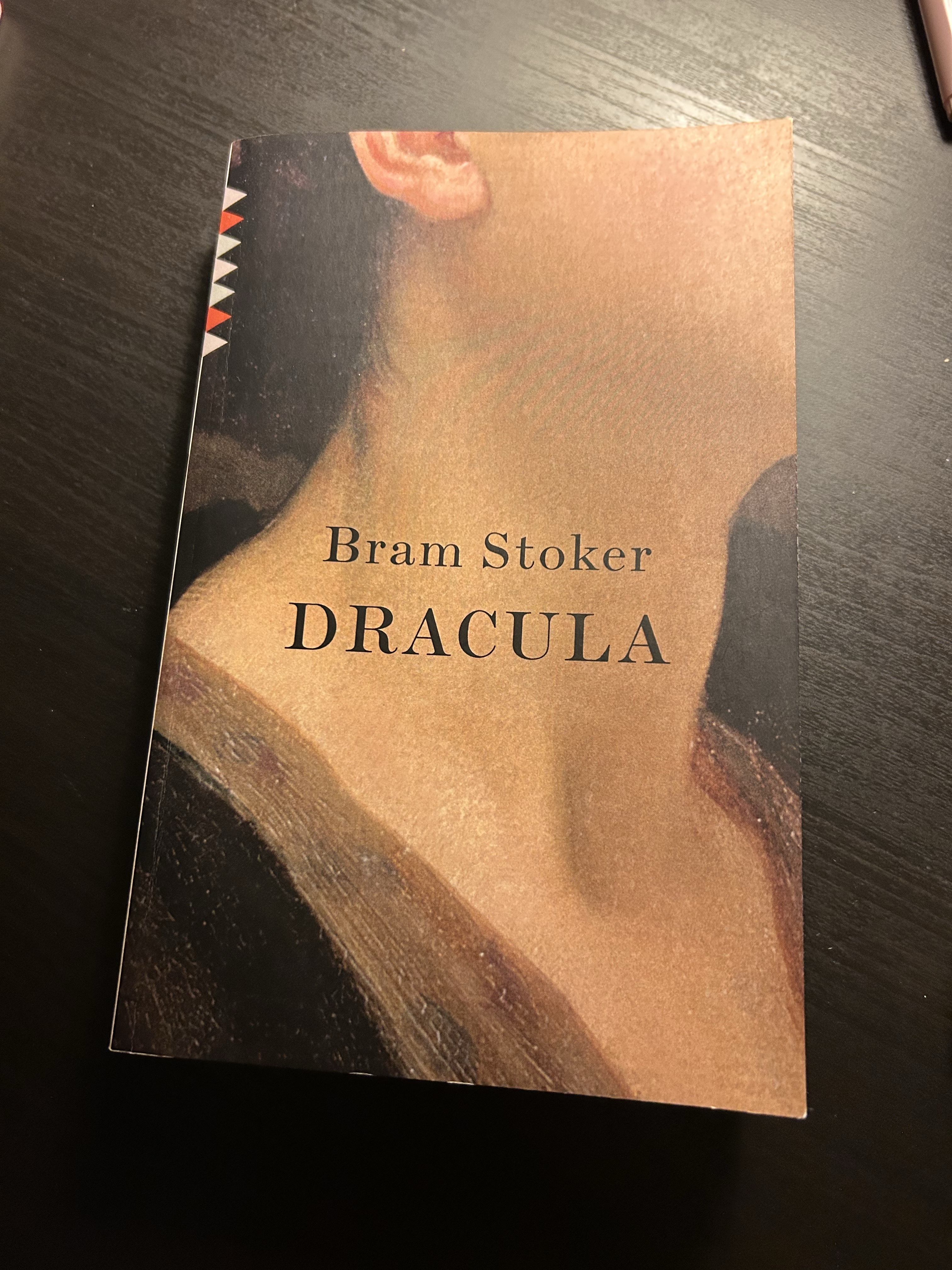
I read Dracula in August of this year. Not the book you think of when you think “Summer Reading,” but sometimes books just find you at the right time and they won’t be ignored.
And as an aside, it’s funny that we associate the novel, the Count, the bats, the entire thing with Halloween, with the dark seasons yet the story itself begins in May. The majority of the book’s action takes place in spring and summer—the seasons of new life and budding blossoms, warm evenings and dazzling sunlight—and only concludes in early November. A lot happens in a mere six months!
I was inspired to read it—to reread it, I originally thought—by Alexander Chee’s excellent essay, which is also a foreword to a new edition of the book. The piece appeared in Guernica in October of last year, but it just found its way to me recently. Like Chee, I hadn’t actually read the book before as I’d thought but unlike Chee I was convinced I had read it. Surely it had been on some reading list at some point during university? Hadn’t I read or tried to read all the gothic classics? But no, everything I knew about Dracula, it turned out, I had gleaned from the 1992 film Bram Stoker’s Dracula.
Chee’s essay is excellent and thought-provoking, and includes some very interesting details relating to Oscar Wilde, Walt Whitman, and Bram Stoker. If you’re like me and you love a good dishy dive into the lives of long-dead writers, you won’t be disappointed. When I finished reading the essay I immediately located my copy of the novel and placed it firmly atop my to-be-read pile.
You probably know the story: a young solicitor is sent to Transylvania to finalize some paperwork for the purchase of several large estates in England for the charming Count Dracula. Jonathan Harker comes to realize pretty quickly that he is a prisoner and his host is not what he seems. Harker manages to escape the castle and flee to Budapest, and spends a good chunk of the book recovering from his ordeal. After his diary entries cease, the novel switches focus back to England and to the diaries and letters of Harker’s fiancée, Mina Murray, those of her friend Lucy Westenra, and, incredibly, the three men fighting for Lucy’s hand in marriage…all on the same day. I don’t know if this was a thing? Just three or more men professing their undying love in a single afternoon like a 19th century episode of The Bachelorette? (I actually don’t know if that happens on The Bachelorette, please don’t be mad at me.) Lucy chooses one, of course, and the others, having been rejected, mope around lovesick but still manage to be involved in her life and it’s great they didn’t go too far for reasons that will become clear.
Soon, while the two women are staying in Whitby, we learn that Lucy is a sleepwalker and this is our first sign that something strange is happening. Lucy’s sleepwalking becomes a real problem and after being brought home one night from the local cemetery (foreshadowing!) where she had wandered, she begins to show signs of suffering from a wasting disease of some sort. Ultimately Van Helsing is summoned from Amsterdam and he recognizes that she has lost a lot of blood which he immediately sets out to replace via transfusion from her strapping young suitors, (see, good to keep them around) only to have it disappear again rapidly and mysteriously. And from this, as well as from the discovery of two small holes on Lucy’s neck, we can surmise that the Count has made it to England.
Another aside: I think the account of the ship bringing Dracula to England is one of my favourite parts of the book. There is real horror to be found in confined spaces, especially on board a ship where your only escape is the briny deep. Much like Harker’s experiences in the castle, being trapped with a madman and with no feasible way out is true terror.
Eventually Van Helsing starts to figure out what’s going on, but it takes the others F O R E V E R to believe him, which checks out I guess, I mean it’s kind of an out there story.
Interestingly, Dracula is a folio novel, as Chee instructs us, “…a sibling to the epistolary novel, posed as letters collected and found by the reader or an editor.” He continues, “In the case of Dracula, the result is one of the world’s most famous stereoscopic narratives, created out of several accounts of people dealing with Dracula, but never an account from Dracula himself. We do not see Dracula sign his name to any of these documents. The novel is a fragmented narrative, as well, but is almost never acknowledged or discussed as such.”
It’s a fascinating—and I might add exhausting—way to structure a novel. Not only do we have letters and diaries from most of the characters, we also have newspaper articles, interviews with townspeople (often written in deep, deep Yorkshire dialect, often very hard to decipher) and medical notes and the sheer amount of organization needed to create such a novel, and one that is nearly 400 pages long, is quite something.
But it’s an interesting study because with Dracula we are gripped by the action, and rarely do we remember that we are reading an account of something that has already happened. The edition I own includes the opening line Chee speaks of in the essay and it is one that I did come back to several times during my reading. Who did put this all together? Who is the editor or archivist of this collection of papers and recordings? “Well, you’d seen the film,” you might be thinking, “So you already know.” But I am here to tell you that despite the title of that early 90s extravaganza, this is not exactly the Bram Stoker’s Dracula they would have you believe.
After I read the book, John and I watched the movie again and because I am an absolute joy to be around, I spent much of the time commenting, “This didn’t happen in the book.” Or if it did, “It didn’t happen that way.” And, “I don’t recall Lucy ever having her tits out in the book.” And look, I understand that filmmakers take liberties and things happen in books that can’t actually happen in real life and even in Hollywood real life, and a lot of this book is about travel and what they’re eating, and did I mention it’s almost 400 pages long? So of course things are changed and altered and shortened because they have to be. But still.
Chee states part way through his essay, “It is hard, in the era of the AR-15, to fear a vampire. And yet what greater tool is there to write about complicity, the amiable foot servant to so much destruction, than a monster who cannot enter unless invited in?”
There is much to take in with this look at Dracula, just as there is much to take in within the book itself. There are the aforementioned descriptions of meals and train and coach travel which tracks, given that these are diaries and letters. There is a lot of business as usual as they go about their days worried for Lucy and then Mina, but only dancing around the actual problem. The men decide it is too dangerous to include Mina in their plans, because of course they do, and instead, they leave her on her own, which is exactly what the monster wants/requires. There are also many, many references to sitting down to breakfast or enjoying dinner before setting out on their vampire hunting, even after exclamations of “There is no time to lose!” or something similar. These characters, you might be thinking, are not very bright. For all their education and standing and—in the case of a few of them, money—they don’t seem to be able to grasp the urgency of the situation. Much like Jonathan Harker in Transylvania ignoring all the signs from the villagers that he’s heading off to his doom, the characters back in England are just as oblivious. And there are times when you do—or at least I did—find yourself rooting for Dracula to just drain them all and be done with it. This is a group of people who look away, who refuse to believe what is happening right in front of them for so long, who wait to act until it is almost entirely too late. And how relevant that feels in our world today.
While I was out there reading Dracula in the real world, the most common question I was asked was, “Is it scary?” And my answer was always, “Yes, but not in the ways you might think.” The beginning of the novel, up to and including the confinement of Jonathan Harker and his experiences in the castle were a masterclass in tension and the kind of writing to keep you up at night. I’ve already mentioned the ship and the terror of knowing a madman is aboard and not being able to do anything about it. I think these stand out for me because they are first-hand accounts of terrifying situations.
The letters, the medical notes and recordings, all the rest are a kind of slow burn as the characters come to terms with what is happening to the people they love and the absolute havoc that could reign should Dracula not be stopped. So, scary, yes, but in the way that the horrors of war or natural disasters are scary when they are reported from thousands of miles away. You know the people involved are afraid, likely terrified, but the distance the letters or the diaries create (or the television or the smartphone) tempers that fear in us and we can watch the story unfold in relative peace. And in the case of Dracula, and in the case of some of the disasters or wars we witness, we have a good idea how the story will end, and so we can read and we can watch and then we can close the book or turn off the broadcast. And that option might be the scariest thing of all.


 Elizabeth Obermeyer
Leave a comment